Saturday, November 7, 2009

Milkmen of the week

This is an extraordinary Morons of the Week, commemorating those wonderful people who preferred to buy their ice cold milk and simple flour for 1000%+ price at 20 yards from the vendor who sells them for normal price.

The first by Phaye:


FoosYou even flipped the achievement bread up to the sky high 22s (yes, silver). Still it was found unethical by our next specimen:


Aronser from Spinebreaker EU also made profit on the retards:


Dorvan of Garona (US) said: I love the holidays. For Day of the Dead, as I logged on the first thing I saw was "[2: Trade] Were do i go 2 find [Simple Flour] lol". Without even taking time to switch to my banker, I loaded Wowhead, found the ingredients for Bread of the Dead (Simple Flour and Milk) and bought 40 of each.


Emmalinna started selling milk after she found them dropped by low level monsters. Later she continued selling from vendor:

Friday, November 6, 2009

My only mount

On the picture you can see my only mount. There is an achievement for 100 mounts, which proves that you can have at least 100 mounts. Yet I have only one. Being druid helps, but my other characters also have 2 mounts, 1 for ground and 1 for flying.

My minipet collection is a bit bigger as quests and events give you pets and you can also buy them for silvers in cities. I used to trade them in the common AH back then and simply equipped some. Still, none of my characters have 25 pets.

Why is it important? Because you can pay 10 real world euros, aka 1 month WoW subscription for a single minipet. I can only quote Mimiron: "Now, why would you go and do something like that?"

Of course I'm not naive, I'm fully aware that Blizzard makes a killing with those things. Most probably they will be followed by other minipets, mounts, tabards, titles and RP clothing. I don't think (yet) that they would dare to sell items with top stats, however I can imagine that they would sell not-top tier emblems or honor.

Let's try to answer to our beloved provider of wonderous rapidity! Did I ever missed some other mounts than my wolf and flight form? Never. Did I ever missed a minipet? Actually I barely call upon any of my existing ones. Let's face it, they are completely pointless.

OK, you might think they are cute and funny. Possibly. But why do you have to own them? I mean I find Lamborghinies beautiful, yet I'm not planning to buy one. Not even to rent one for a weekend, although I could afford that easily. Every time I see one on the street, I turn after it, admire it, and move on my way smiling (not ironically, but filled with beauty). So, why do you have to buy it to receive its "cuteness". You could just walk to any pet in Dalaran and watch it!

The answer is pretty sad: people want to own these things because they believe that the Joneses doesn't have them yet, or even worse, they already have one and will look down on us if we can't keep up. If I'd have to point out one reason from many why I'm goldcapped in WoW and do pretty well IRL (granted, not Lamborghini-well, but with enough deposit to be unemployed for 3 years without a drop in my lifestyle), that one reason would be: "I don't give a damn about the Joneses". As far as an item serves me well, I don't care if it's old, out of style, "cheap" or whatever way unapproved by the Joneses.

WoW is a fantasy game. Joneses doesn't care about your mount or minipet. It's just pixels for them. Why don't you give the "what would they say about my stuff" idea a break, at least in WoW. Don't buy panda or lilKT! You'll see that no one will insult you for that (not like their words would make any difference). Why don't you get out of the threadmill at least in the video game you play?!

Most people will sooner or later buy minipets because they feel they are looked down by peers if they wouldn't. These MMOs, despite their fantasy or sci-fi settings are actually social places, where the actions of social people are governed by the same ape-subroutines. However in the game this behavior is obviously pointless and ridiculous (while in real life it's obvious only to a sociopath). I seriously believe that the biggest benefit of these games is exactly that: illuminating how obviously wrong the social people are.


PS: yes, fragment of this post appeared yesterday, as I wrote it and accidently post it instead of saving.

PS2: I bought the frostwolf at lvl60 while farming honor for lvl70 gear. I thought it's easier to win AV on 60 in enchanted lvl55-60 blues than against PvP geared lvl70-es. The marks back then could not be used for much, so I actually saved the price of the faction mount.

Thursday, November 5, 2009

Gervais principle

I got this link long-long time ago. It's a hard read and was unsure that I could turn it into anything that fits to the blog. It's not only I cannot just copy&paste someone else's idea (that's too easy to catch in the age of google), but also I was unsatisfied with the idea itself, despite its obvious brilliance.

It's based on the TV series the Office, that is more than just a gag-series, it's a Dilbert-like cynical philosophy about corporations, along the line: "organizations don’t suffer pathologies; they are intrinsically pathological constructs. Idealized organizations are not perfect. They are perfectly pathological."

I couldn't agree more as no one (except the owner) is motivated for the success of the organization, merely for his own personal goals. It also explains a fact that is hard (or impossible) to explain by any existing management schools: "why do corporates always reorganizing, merging, splitting, laying off...". I mean if there would be some "good" management scheme, then someone would achieve it by now (even by luck), therefore this perfect organization would be stable and endure everything.

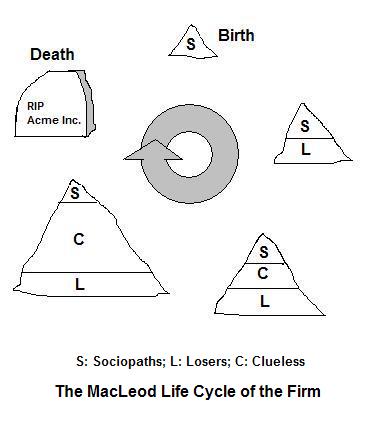
This idea presents the following scheme:
It appears to be true and simple, so it's quite easy to fall in love with at first sight. However the explanation for it is quite made up and lacks the style and simplicity.

It introduces the "sociopaths" as "Darwinian/Protestant Ethic will-to-power types who drive an organization to function despite itself". Cold-hearted businessmen and managers who comes up with a good idea, then do what must be done.

The description of "losers" is also correct: "they are primarily losers in the economic sense: those who have, for various reasons, made (or been forced to make) a bad economic bargain: they’ve given up some potential for long-term economic liberty (as capitalists) for short-term economic stability. Traded freedom for a paycheck in short." However I don't necessarily see them as "losers". I'd rather use the term "grinders", as they do repetitive work, but still, they are supporting themselves, which is not "loser" for me.

However the emerging layer of "clueless" is a major problem. The Gervais-principle says: "As it [the organization] grows it requires a clueless layer to turn it into a controlled reaction rather than a runaway explosion." is simply nonsense. Later it's telling that the clueless are created by the sociopaths for their own short-term goals, usually to take a fall or as scapegoats: "The simple reason is that if you over-perform at the loser level, it is clear that you are an idiot. You’ve already made a bad bargain, and now you’re delivering more value than you need to, making your bargain even worse. Unless you very quickly demonstrate that you know your own value by successfully negotiating more money and/or power, you are marked out as an exploitable clueless loser." This is nonsense. Such cases exist but rare, exactly because the scapegoat is built for sacrifice, so they cannot stay, therefore their current number is any time low. Also, as an anecdotal evidence, as a sociopath, I can guarantee that we don't feed this type.

So let me give a much better explanation of the cycle: the "clueless" are actually "the socials". People with no skill in what they supposed to do, nor with creative skills, but skills in manipulating other people, mainly the grinders. The "clueless" or "social" layer in the company is not created by anyone, especially not by the sociopaths. They emerge on their own using their connections and power over the grinders. They are obviously incompetent for their job, yet they can keep it because everyone around them like them or at least finds it "unethical" to remove them. They usually has the social skills to make a good first impression to have a chance, then they take it by manipulating the feelings of the people around them. They run under the flag "it wasn't my fault". They are pretty good to blame failures on non-personal actors like "bad luck", or even if it's clearly their fault, they can blame it on "mistake" or result of "good intentions".

The other major way of their emergence is that they were useful grinders once, but they got old, sick, depressed or simply their job changed or disappeared due to market effects. Yet they can stay inside the organization, either in their former job, or in a fake job created exactly for them. In this case often the law make them stay: it's pretty hard and expensive to fire someone simply because he is useless in several countries. It's easier in the short term to keep them in some jobs.

They can stay because they seduce the grinders around them. If the middle manager is another social or grinder (what is quite probable), he doesn't even think of touching them, while a sociopath must think twice before removing them, since the cost is the hate and despair of all people in the department. The reason for despair is that they see the social as "one of us", as they are unable to see that the social actually does nothing useful, so they fear they will be the next. After all, he was "loyal, hard working, selfless". In the eyes of grinders and socials these are more important values than competence (that's why they are grinders at the first place). So the sociopath is forced to keep the social to prevent a serious moral drop among his minions.

The number of socials does not just grow, it grows exponentially, as the more they are, the harder it is to keep any kind of competence standard. This way they soon reach the point when the hard work of the grinders can not provide for them and the company collapses. After, or soon before this point one of the sociopath start a reorganization plan, when he conspicuously moves departments and branches, but actually just lays off most of the socials with some grinders (collateral damage). The reorganization has to be big to hide the fact that it was targeted against the socials. The sociopath here uses the social trick: "it wasn't my fault, the economy forced my hand". With the losers remaining losers, the cycle starts again, collecting socials into the organization.

So reorganizations are actually spring cleanings in order to cleanse the organization from (non-loser) socials.

You can see it in non-top WoW guilds all the time. They are started by a core of relatively good players, and first collect people who are ready to farm, put things to guildbank and accept lower loot priority as trials. But over time the guild start collecting socials who mess up the raid and create drama, yet they cannot be kicked without huge drama. Sooner or later the guild breaks and new one is formed by those who could actually play (sociopaths and grinders).

Wednesday, November 4, 2009

The best thing you can do to a moron

Let's say you want to do something good to the morons around you. Seth is in this position, since one of his RL friend just told him that he makes 50G/day. Not /minute, day! He is unsure if telling this moron to farm herbs for low is a moral idea.

Well, it's the only idea that helps this guy. Giving him an hourly paid job is the best thing you can do for him.

Oh wait? You could give him gold as a gift, right? No, you can't! You simply don't have enough gold for that. I mean you could help one moron, but why him? What about the others? I make 10-12K a week (yes I know, I'm lazy). The server has 4-5K horde players. So I could give them 2-3G/week. That wouldn't be much of a help. Of course I could focus on a few, but why them, why not others. It's unjust and unfair!

On the other hand if I give him an hourly paid job, I let him have gold without losing mine, therefore losing my ability to "help" others. Theoretically I could give a job to every single players on the server (of course I lack the time, but not the gold).

What guarantees that I don't pay him too little? My competition does. If they offer higher wages, he could go there. I have no competition? Than any payment is better than nothing. BTW in WoW this is not true, since the quest givers offer infinite amount of jobs for 200-250G/hour.

There are two reasons why people run around without jobs:
  • the lack of goblins who could give them jobs
  • their own rejection against jobs. This is based on mostly an ape-subroutine "dignity".
I just thought how many employees I could have in the glyph business:
  • herb-farmers: I pay them market_price-X% for herbs, X depends on my competition's offers, my guess is 20%
  • millers: I can pay them 20-30s/milling + inking, just make sure to count the inks I get back
  • crafters: that would be the big shot. I make a queue and link it to him and he crafts them. Someone could write a queue macro that let me send my queue to someone. I give him the inks and parchments and pay him 20-30s/glyph
This way I could decrease my workload drastically.

If there would be enough goblins in the world, there would be no poor, except the outright lazy or completely retarded. There would be jobs created everywhere. Too bad we are so few, because without competition we can make so much money that we are not motivated to give jobs. I mean it's easier for me to do the whole glyphs industry alone for a week and don't touch a glyph for another 4 weeks than organizing my employees every day. I could make much more gold with that, but why? To make a goldcapped alt? If I'd had to struggle for my economic freedom, I'd employ people.

However if I'd be a nice person I would waste this time just to help them, by employing them.

Tuesday, November 3, 2009

Business or gambling?

I got record amount of comments on the post about my pricing method. Most of them go along the line "It wouldn't work on my server", claiming that their method are superior, despite the poor results compared to mine. Of course the limited success is caused by "bad server". (everything above daily G/hour is success just in different amounts)

So I'm making continued effort to analyze the QA2-undercutting strategy, trying to prove that the strategy is naturally flawed and necessarily provide poor results.

Let's state the obvious: if some NPC would buy glyphs for 50G, than every living body would be crafting glyphs and selling to him (assuming that herbs are available at their current price). It's also obvious that the glyph buyers are not NPCs, and won't buy that many. In economy terms: for 40-50G the supply is vastly bigger than the demand. The QA2 wizards handle this problem by 1c undercutting. If your glyph is the cheapest it is the one that's sold and the others are not.

When you undercut an 50G glyph by 1c (or post a glyph for 50G on an empty market), you are actually gambling. You place a bet that a buyer will arrive first and not a competitor. If buyer comes, your glyph sells and you get huge profit. If competitor comes, you won't sell and your glyph returns or you are forced to undercut, so you lost some worktime.

As in every gambling action your odds can be calculated. It is exactly: demand * your_cycles / competitor_cycles. Demand is the number of glyphs sold daily, your_cycles is the number of times you check the AH for cancel-repost, competitor_cycles is obvious. If you double your cycle number, your profit will double. If you put your competitor to friend list, and post after their logoff, you not only added one to your own cycles, but decreasing one of theirs. If you are online 24/7 and have everyone on friend list, you can instantly undercut, therefore own the whole market.

So in the QA2-undecutting game your only choice to increase your sells is camping harder. If everyone else plays QA2-undercuts, sells=profit as price is high.

My pricing is giving higher gold/hour active time and also allows me to batch my work. I don't have to camp the AH, I can assign time to my actions when I want to, with the only restriction to be within 48 hours. It is important to notice that a QA2-undercutter makes more gold than I do on the same market, however at the cost of much more time online and the (hardly quantifyable) "must check the AH every hour" unpleasant condition.

At first I use Auctioneer to determine market price. Many people claim that market price have no meaning. Actually it has: it holds the competitor activity. Price reset can happen when the buyers consumed all of the competition's glyphs. This case you can cancel yours and repost at 50G (or whatever fallback price) and still be the cheapest. A reset requires that buyers arrive in a row, buying all of them. If one of the competitors arrive before all glyphs are sold, he simply list more at the current price. If there are more competitors, there are more glyphs so it needs more buyers to clear the AH. Since they arrive in a random time, the chance of their random aggregation decreases rapidly with their number needed for a successful reset. If the resets are less frequent, more undercuts happen, so the price slowly climbs down. The market price of 30G means that repost_cycle:reset = 20G/undercut_value.

By using this price I adjust to the number of competitors. The more they are, the lower the price is. My first move is making random resets impossible and forced resets (buying all up) expensive and risky. Remember, if you buy my glyphs up and post at 50G, you may sell nothing before your competitor arrives. This case you lost your buyout gold for nothing. If the competitor number grows, my price lowers, so you have to risk less money to buy me out, but you have less chance to sell before one of the many competitors arrive.

My second move is slowly driving the prices down. Without resets, even with 1c undercuts the price will crawl down. I add my 60s undercut value to this. I can easily drive a 50G price into the mud in two weeks using only automated processes.

Why is it good for me? Because there are two possibilities:
  • the competitor gives it up, abandons that glyph (by having a higher threshold or simply by leaving the market). This case I post a bit higher automatically and have 5-8G profit on a glyph.
  • the competitor keeps undercutting, this case I sell nothing, so I don't have to craft, so I don't waste time.
I either have a nice profit or no work. That guarantees my sky-high gold/hour. The only case when I sell for 3-4G is the one session when the competitor gives it up. My glyphs are out, and with the competition gone, are the cheapest so sold. That is the only time I suck. But next time I can post higher (and automatically do) as I'm out of competition.

The point is that until the competitor is there, I'm safe from selling = working.

If the competition is very determined, I'm selling nothing at all, so I have practically 0 workload. Since I keep on decreasing the price with no chance of reset, his profit is closing to 0. There is no way that someone can keep up his determination with no profit, nor even the chance of profit.

You can claim that he can save himself by setting a 5G threshold. That case I will sell for 4.xx G. That's true. However here comes my savior, another QA2 wizard with 4.99 threshold! I've seen such funny threshold-undercut-war many times.

My safety-threshold is applied on crafting. If the price is too low, I stop crafting, but I use the existing glyphs to keep the price low, for the amusement of the competition.

The fundamental fault of the QA2 game is being more work intensive. I lose less time by selling for low than my competitors, so I can go deeper in price. My work-overhead is decreased by batching. Logging on 10 times a day cost time itself along with the annoyment. Me on the other hand can schedule the crafting session to the moment when it's less painful and have enough offline stuff available to decrease time lost.

By driving the price to the point where supply = demand, I have a stable business (as opposed to gambling) and I can decide if I want that business. If I don't I don't craft glyphs. Of course if the prices would reset in my absence, next time I post again, at the old market price, destroying the effect of reset. So I can set my crafting threshold to an arbitrarily high price (currently 6G) and still sell, simply by making the QA2 game so time-ineffective that all my competitors give it up sooner or later.

The only one dangerous to my scheme is my mirror image. This case we'd automatically share the market according to our crafting threshold. If I posted a glyph for low profit, he won't craft, and won't post, mine sell. If he did it, his sell. Our G/hour will be equal to the G/hour expectation of the one who is ready to work cheaper. If he needs gold more than I do and ready to work for less G/hour, he can make me not sell. However he can't drive me out or elevate his G/hour since I'd immediately start crafting and selling. My standby workload (relisting every 48 hours) is close to 0.

Your only real resources are time and skill. If we assume that 2 goblins use the optimal strategy, we arrive to the point that only time spent on business makes difference between them. If everyone would be an AH goblin, everyone in the server would have equal G/hour. My 3-4K G/hour (active time hours, excluding long auctioneer posting or clicking the mailbox once a minute while cleaning my home) comes from the fact that most people have no idea about economics and only do what MMO-champion tells them.

The aim when fighting with QA2 wizards is not stopping them from selling. You can't do that anyway without being one of them. The point is to stop yourself from selling while making everyone else sell at loss, making them leave. I usually do my glyph listing at the morning or early afternoon, to make sure that the QA2 wizards have enough time undercutting me before the buyers come in the evening.

One more tip: if the "pro ppl" are already selling below material cost, buy them out. Not to cause a reset, but to make them craft more, therefore driving them deeper in loss. As they craft, they not only wasting time, but driving herb prices up, making it harder for themselves to craft more. You can just sell the bought glyphs later. Just don't do it with leveling glyphs.

PS: it's funny that whenever I post something "philosophical", people comment "go back to WoW". When I post something as direct as it can be, they simply don't believe it or blame luck for my G/hour.

PS2: There are some clueless who claim that since they don't undercut by 1c, they are different from other QA2 wizards. The defining characteristic is the undercut-fallback cycle. If a QA2 wizard finds the market empty, he posts on an arbitrary high fallback price, while I post on old market price +25%. He welcomes undercutters back, I don't.

PS3: QA2 became famous back in the day when most servers had no or just 1-2 sellers. Nowadays (thanks to MMO champion) there are dozens on every servers. Most of them are desperate kids who put all their gold into starting an industry, so they will waste all the time they have (and they have a lot) to undercut you. You could make good money with QA2 back then. Now, when everyone else does the same, you have to beat the trend to win.

Monday, November 2, 2009

Generation Y my ass

The net is full of this generation Y nonsense. If you are in the happy minority who has never encountered this, Tobold summed it up well. The main point is that the generation born after 1982 are different from the 65-81 generation, named generation X, who are competitive and lone wolves.

This nice generation Y is "lot more social oriented (not unlike baby boomers), cooperative, and prefer games that hand out rewards left and right, and are very forgiving."

I see this nonsense spreading and can't see how intelligent people can fall for it. For God's sake, "generation Y" is simply kids and young adults. Of course they are social and forgiving. Want to laugh your ass off? I found an essay that I wrote for a high-school competition for the theme "a new, better world". I wrote about the necessity of basic income, government funded education and health care. I explained why the people with incomes should support those who "are not there yet".

I was a silly kid, what on Earth did you expect from me? It was obvious for me that everyone want and can work after schooling is complete and unemployed can be nothing else than unlucky.

I can't remember a single essay that would support any form of "the person responsible for himself" idea. Actually my essay was a pretty right-wing as basic income, education and health care is available to everyone in the country, while most essays demanded direct social transfers targeted to the poor or to the Africans or whatever.

Then I grow up, so did my classmates. I work as an engineer, hating tax, spending my free time spreading anti-social ideas. Some of my former classmates turned into welfare leeches, most of them are employed and hate welfare leeches. The girl who won the contest and read up her essay between tears (it was about how could we end the famine of Africa by everyone working 2 months/year for free in the lucky countries) is currently the director of a marketing agency and last time we met she was telling how much money she made on the "morons who buy shit just because my ads tell them that they are losers in life otherwise".

We grow up. "Generation Y" will learn that there is no free lunch. One day they will leave the school and find that the prospective employers don't "hand out rewards left and right, and are very forgiving".

And instead of whining, here comes a praising of Blizzard's new anti-social patch 3.3. You no longer need to even talk to the people around you. Just queue up for the instance, the system will assign you groupmembers, you shall only do your job. If someone doesn't does his, he'll be voted out.

This voting out system will be the most anti-social thing that was ever included to a video game, making Darkfall a "hand out rewards left and right, and are very forgiving" game. Being ganked by a single jerk is one thing. Being told by 4 people that "you suck and we want you out" is very different.

Also, the "people from your ignore list will not be in your random group" will be a great tool to blacklist suckers.

Do you think Blizzard has not planned it without careful research? They never made a bad major move. If I'd have to guess, the next generation will be much less social than ours. The "social" motto of the new generation could be: I want people around me. I don't care who they are as long as they serve me well. If they leave, I don't care, someone else will come.

Subscribe to the goblinish wisdom

My Blog List